27. The major advantage of English
A short history of English uncovers how its speakers can access 10 living languages

Native English speakers have always been at a disadvantage when it comes to learning foreign languages: there isn't really a burning need to learn another language1.
There is one major linguistic advantage: anyone who speaks English has access to at least 10 living languages. Modern English is a Germanic language that has had many Latin influences. Both sub-groups are from the Indo-European language family.
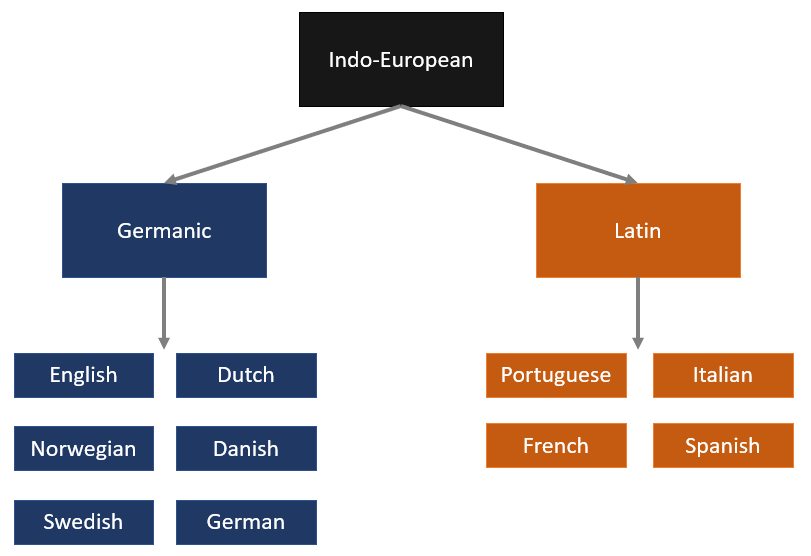
To understand how to use English to tap into these other languages, we first have to understand its history.
The origins
English was initially formed from a mixture of dialects that were the common speech of Germanic tribes (called the Angles, Saxons, and Jutes) who came to Britain between 400 and 700 CE. After that, Norse invaders contributed a few Scandanavian words to English (an example is the suffix -by (small town) - e.g. Whitby, Grimsby.
Latinisation
In 1066 the Normans arrived in England. Before this, the language of England was almost purely Germanic. The language changed significantly after the conquest, but this latinisation of English didn't begin immediately. For most of the two centuries after the conquest, two languages were spoken. The overlords spoke Norman French whilst the English serfs spoke Old English. Later in the Middle Ages, more Latin words came into English, through the influence of scholars and writers.
As a result of these various additions, there are often two English words for the same concept - one Germanic and the other Latin. For example, forgive (Germanic origin) and pardon (French origin). The Germanic words are usually more intimate since it was the language of the people, whilst the Latin/ French is more formal since it was the language of nobility, priests, and scholars.
An interesting example of these are livestock and their food. The animals have native names (sheep, pig, calf, ox), but when they reach the Norman overlord's table they have become (mutton, pork, veal, beef) from the French (mouton, porc, veau, boeuf). Here are some more examples.
Greek influence
The Renaissance went hand in hand with a renewed interest in Greek philosophy, so in from the sixteenth century there was an influx of Greek words. Later, scientists would also adopt Greek roots to build new words - many technical terms have Greek origins.
ph, pronounced like f (phonograph, philosophy)
ch, pronounced like k (chorus, Christianity)
rh ( rheumatism, diarrhea)
ps where the p is silent (psychology, pseudonym)
Many prefixes (e.g. anti-, apo-, dys-)
How to use this to learn other languages
When learning vocabulary from another related language, you should try to draw bridges between that language and English. You have to first recognise the origin of an English word and then understand any sound shifts between English and the other language you’re learning. E.g. a silent gh usually means the word is Germanic. There is a sound shift from gh in English to ch in German, so you can easily understand the following German words: licht, nacht, racht (light, night, right).
I was initially going to list out all the sound shifts for the Germanic and Romance languages, but I decided against this. Most of this information is in the Loom of Language2, which I recommend reading. The chapter ‘How to Learn a Basic Word List’ will help you understand how to easily build up vocabulary of a foreign language.
I’ll highlight just two examples of how these sound-shifts allow you to recognise familiar words in other languages.
1. Germanic
There are a number of signposts of words that have Germanic origin:
th (thaw, then, thin)
sh (sheep, shield, ship)
gh (laughter, through, rough)
An initial w (ware, wasp, wash)
An initial sk (skin, skirt, sky)
Prefixes - e.g. be- (behind, belong), or the endings -some, -dom, -hood, -head, -kind are all of Germanic origin.
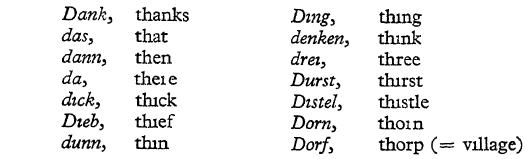
Once you know the origin of a word, you have to understand the sound shifts that have taken place (in English, and in other languages). For example, th has changed to a t or a d in other Germanic languages. Here's a table of some English and German words that illustrate this sound shift:
2. Latin
Some clues of a Latin origin:
The combinations ct, ti, sc (action, scale, nation)
Words containing the a ‘zh’ sound (vision, treasure)
Words beginning with j and g, pronounced as J (gentle, giant, jacket)
Nearly all words containing oi (boil, moisture, soil)
All words in which ou stands for a long u (group, soup, tour)
Words beginning with cha, where ch = tsh (challenge, change, charm
Words with a ending with gue or que (fatigue, brusque)
Words beginning with qu (quarter, quality)
All words in which the final s and t are silent (debris, bouquet)
Nearly all words ending in ant, ent (agent, merchant, student)
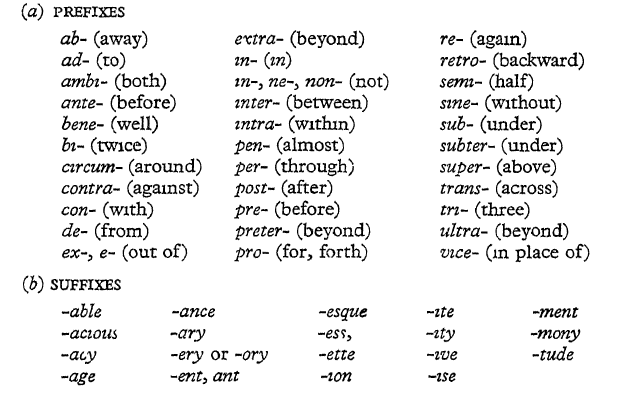
There are also many prefixes and suffixes that give clues of a Latin heritage.
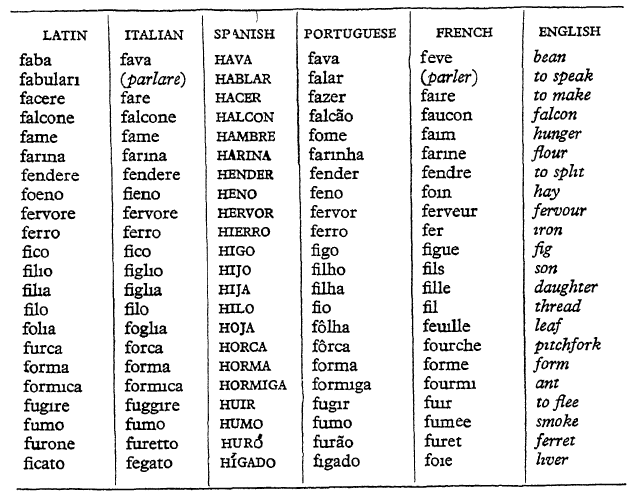
Here’s an example of a sound shift you can use when learning other languages. Latin started to break up into other languages, and the sound shifts are slightly different in each of them. By understanding these you can easily adapt the vocab you’ve learnt in one Latin language to another.
This example shows the shift of f to silent (i.e. h) in Spanish.
I recommend reading The Loom of Language if you’re looking to learn any of these languages - you can make the process much easier by using some clever tricks.
To be clear, I’m all for learning languages - the intellectual stimulation, the cultural experiences, and the deeper connections.
This name might be familiar if you’ve read Malcolm X’s autobiography. He mentions it as one of the books that changed his life